Khóa học
IELTS Online
IELTS Online
Giảm đến 18%
Đăng ký ngay
Mục lục [Ẩn]
IELTS Listening Cam 16 Test 1 là một đề thi quen thuộc với nhiều người học IELTS, tuy nhiên không ít thí sinh vẫn mất điểm đáng tiếc do hiểu sai bẫy thông tin hoặc chưa nắm vững chiến lược làm bài. Việc nắm rõ nội dung bài nghe và phân tích kỹ từng đáp án sẽ giúp bạn tránh lỗi thường gặp và cải thiện điểm số hiệu quả. Trong bài viết dưới đây, Langmaster sẽ cung cấp bản dịch chi tiết, giải thích đáp án và hướng dẫn cách làm từng phần để bạn luyện tập hiệu quả và tự tin hơn khi bước vào phòng thi.
Dưới đây là toàn bộ đáp án đề thi IELTS Listening Cam 16 Test 1 bạn có thể tham khảo:
|
1. FALSE |
11. Photographer |
21. city |
31. G |
|
2. FALSE |
12. game |
22. priests |
32. E |
|
3. Not given |
13. frustration |
23. trench |
33. C |
|
4. TRUE |
14. IV |
24. location |
34. F |
|
5. TRUE |
15. VII |
25. B |
35. B |
|
6. FALSE |
16. II |
26. D |
36. A |
|
7. TRUE |
17. V |
27. B |
37. C |
|
8. violent |
18. I |
28. D |
38. A |
|
9. tool |
19. VIII |
29. C |
39. B |
|
10. meat |
20. VI |
30. D |
40. C |
READING PASSAGE 1
You should spend about 20 minutes on Questions 1-13 which are based on Reading Passage 1 below.
|
Why we need to protect polar bears A Polar bears are being increasingly threatened by the effects of climate change, but their disappearance could have far-reaching consequences. They are uniquely adapted to the extreme conditions of the Arctic Circle, where temperatures can reach -40°C. One reason for this is that they have up to 11 centimetres of fat underneath their skin. Humans with comparative levels of adipose tissue would be considered obese and would be likely to suffer from diabetes and heart disease. Yet the polar bear experiences no such consequences. B A 2014 study by Shi Ping Liu and colleagues sheds light on this mystery. They compared the genetic structure of polar bears with that of their closest relatives from a warmer climate, the brown bears. This allowed them to determine the genes that have allowed polar bears to survive in one of the toughest environments on Earth. Liu and his colleagues found the polar bears had a gene known as APoB, which reduces levels of low-density lipoproteins (LDLs) – a form of ‘bad’ cholesterol. In humans, mutations of this gene are associated with increased risk of heart disease. Polar bears may therefore be an important study model to understand heart disease in humans. C The genome of the polar bear may also provide the solution for another condition, one that particularly affects our older generation: osteoporosis. This is a disease where bones show reduced density, usually caused by insufficient exercise, reduced calcium intake or food starvation. Bone tissue is constantly being remodelled, meaning that bone is added or removed, depending on nutrient availability and the stress that the bone is under. Female polar bears, however, undergo extreme conditions during every pregnancy. Once autumn comes around, these females will dig maternity dens in the snow and will remain there throughout the winter, both before and after the birth of their cubs. This process result in about six months of fasting, where the female bears have to keep themselves and their cubs alive, depleting their own calcium and calorie reserves. Despite this, their bones remain strong and dense. D Physiologists Alanda Lennox and Allen Goodship found an explanation for this paradox in 2008. They discovered that pregnant bears were able to increase the density of their bones before they started to build their dens. In addition, six months later, when they finally emerged from the den with their cubs, there was no evidence of significant loss of bone density. Hibernating brown bears do not have this capacity and must therefore resort to major bone reformation in the following spring. If the mechanism of bone remodelling in polar bears can be understood, many bedridden humans, and even astronauts, could potentially benefit. E The medical benefits of the polar bear for humanity certainly have their importance in our conservation efforts, but these should not be the only factors taken into consideration. We tend to want to protect animals we think are intelligent and possess emotions, such as elephants and primates. Bears, on the other hand, seem to be perceived as stupid and in many cases violent. And yet anecdotal evidence from the field challenges those assumptions, suggesting for example that polar bears have good problem-solving abilities. A male bear called GoGo in Tennoji Zoo, Osaka, has even been observed making use of a tool to manipulate his environment. The bear used a tree branch on multiple occasions to dislodge a piece of meat hung out of his reach. Problem-solving ability has also been witnessed in wild polar bears, although not as obviously as with GoGo. A calculated move by a male bear involved running and jumping onto barrels in an attempt to get to a photographer standing on a platform four metres high. F In other studies, such as one by Alison Ames in 2008, polar bears showed deliberate and focussed manipulation. For example, Ames observed bears putting objects in piles and then knocking them over in what appeared to be a game. The study demonstrates that bears are capable of agile and thought-out behaviours. These examples suggest bears have greater creativity and problem-solving abilities than previously thought. G As for emotions, while the evidence is once again anecdotal, many bears have been seen to hit out at ice and snow-seemingly out of frustration- when they have just missed out on a kill. Moreover, polar bears can form unusual relationships with other species, including playing with the dogs used to pull sleds in the Arctic. Remarkably, one hand-raised polar bear called Agee has formed a close relationship with her owner Mark Dumas to the point where they even swim together. This is even more astonishing since polar bears are known to actively hunt humans in the wild. H If climate change were to lead to their extinction, this would mean not only the loss of potential breakthroughs in human medicine, but more importantly, the disappearance of an intelligent, majestic animal. |
Questions 1-7
Do the following statements agree with the information given in the passage? In boxes 1-7 write
| TRUE | if the statement agrees with the information |
| FALSE | if the statement contradicts the information |
| NOT GIVEN | if there is no information on this |
1 Polar bears suffer from various health problems due to the build-up of fat under their skin
2 The study done by Liu and his colleagues compared different groups of polar bears.
3 Liu and colleagues were the first researchers to compare polar bears and brown bears genetically.
4 Polar bears are able to control their levels of ‘bad’ cholesterol by genetic means.
5 Female polar bears are able to survive for about six months without food.
6 It was found that the bones of female polar bears were very weak when they came out of their dens in spring
7 The polar bear’s mechanism for increasing bone density could also be used by people one day
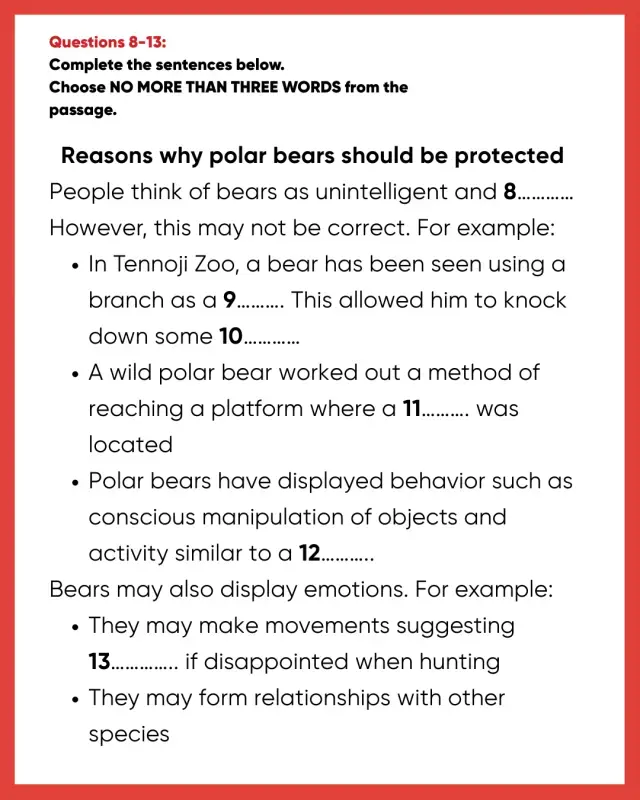
Questions 8-13
Complete the sentences below.
Choose NO MORE THAN THREE WORDS from the passage.
|
Reasons why polar bears should be protected People think of bears as unintelligent and 8………… However, this may not be correct. For example:
Bears may also display emotions. For example:
|
Nguồn: Internet
Trên đây là toàn bộ đề thi Cam 16 test 1 Passage 1: Why we need to protect polar bears, bạn có thể tham khảo bài dịch và giải thích đáp án chi tiết TẠI ĐÂY.
>> Xem thêm: Giải đề The study of chimpanzee culture IELTS Reading Actual Test Vol 6 Test 2
READING PASSAGE 2
You should spend about 20 minutes on Questions 14-26 which are based on Reading Passage 2 below.
|
The Step Pyramid of Djoser A The pyramids are the most famous monuments of ancient Egypt and still hold enormous interest for people in the present day. These grand, impressive tributes to the memory of the Egyptian kings have become linked with the country even though other cultures, such as the Chinese and Mayan, also built pyramids. The evolution of the pyramid form has been written and argued about for centuries. However, there is no question that, as far as Egypt is concerned, it began with one monument to one king designed by one brilliant architect: the Step Pyramid of Djoser at Saqqara. B Djoser was the first king of the Third Dynasty of Egypt and the first to build in stone. Prior to Djoser’s reign, tombs were rectangular monuments made of dried clay brick, which covered underground passages where the deceased person was buried. For reasons which remain unclear, Djoser’s main official, whose name was Imhotep, conceived of building a taller, more impressive tomb for his king by stacking stone slabs on top of one another, progressively making them smaller, to form the shape now known as the Step Pyramid. Djoser is thought to have reigned for 19 years, but some historians and scholars attribute a much longer time for his rule, owing to the number and size of the monuments he built. C The Step Pyramid has been thoroughly examined and investigated over the last century, and it is now known that the building process went through many different stages. Historian Marc Van de Mieroop comments on this, writing ‘Much experimentation was involved, which is especially clear in the construction of the pyramid in the center of the complex. It had several plans … before it became the first Step Pyramid in history, piling six levels on top of one another … The weight of the enormous mass was a challenge for the builders, who placed the stones at an inward incline in order to prevent the monument breaking up.’ D When finally completed, the Step Pyramid rose 62 meters high and was the tallest structure of its time. The complex in which it was built was the size of a city in ancient Egypt and included a temple, courtyards, shrines, and living quarters for the priests. It covered a region of 16 hectares and was surrounded by a wall 10.5 meters high. The wall had 13 false doors cut into it with only one true entrance cut into the south-east corner; the entire wall was then ringed by a trench 750 meters long and 40 meters wide. The false doors and the trench were incorporated into the complex to discourage unwanted visitors. If someone wished to enter, he or she would have needed to know in advance how to find the location of the true opening in the wall. Djoser was so proud of his accomplishment that he broke the tradition of having only his own name on the monument and had Imhotep’s name carved on it as well. E The burial chamber of the tomb, where the king’s body was laid to rest, was dug beneath the base of the pyramid, surrounded by a vast maze of long tunnels that had rooms off them to discourage robbers. One of the most mysterious discoveries found inside the pyramid was a large number of stone vessels. Over 40,000 of these vessels, of various forms and shapes, were discovered in storerooms off the pyramid’s underground passages. They are inscribed with the names of rulers from the First and Second Dynasties of Egypt and made from different kinds of stone. There is no agreement among scholars and archaeologists on why the vessels were placed in the tomb of Djoser or what they were supposed to represent. The archaeologist Jean-Philippe Lauer, who excavated most of the pyramid and complex, believes they were originally stored and then give a ‘proper burial’ by Djoser in his pyramid to honor his predecessors. There are other historians, however, who claim the vessels were dumped into the shafts as yet another attempt to prevent grave robbers from getting to the king’s burial chamber. F Unfortunately, all of the precautions and intricate design of the underground network did not prevent ancient robbers from finding a way in. Djoser’s grave goods, and even his body, were stolen at some point in the past and all archaeologists found were a small number of his valuables overlooked by the thieves. There was enough left throughout the pyramid and its complex, however, to astonish and amaze the archaeologists who excavated it. G Egyptologist Miroslav Verner writes, ‘Few monuments hold a place in human history as significant as that of the Step Pyramid in Saqqara … It can be said without exaggeration that this pyramid complex constitutes a milestone in the evolution of monumental stone architecture in Egypt and in the world as a whole.’ The Step Pyramid was a revolutionary advance in architecture and became the archetype which all the other great pyramid builders of Egypt would follow. |
Questions 14-20
Reading Passage 2 has seven paragraphs, A-G.
Choose the correct heading for each paragraph from the list of headings below.
Write the correct number, i-ix, in boxes 14-20 on your answer sheet.
List of Headings
| i | The areas and artefacts within the pyramid itself |
| ii | A difficult task for those involved |
| iii | A king who saved his people |
| iv | A single certainty among other less definite facts |
| v | An overview of the external buildings and areas |
| vi | A pyramid design that others copied |
| vii | An idea for changing the design of burial structures |
| viii | An incredible experience despite the few remains |
| ix | The answers to some unexpected questions |
14 Paragraph A
15 Paragraph B
16 Paragraph C
17 Paragraph D
18 Paragraph E
19 Paragraph F
20 Paragraph G
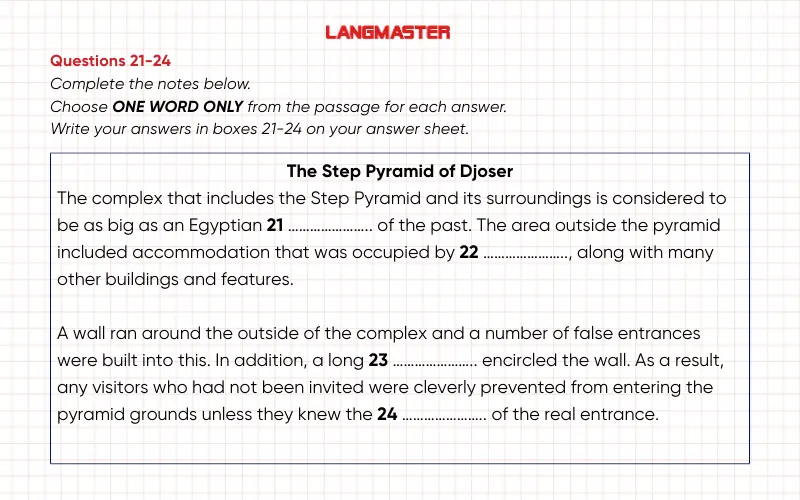
Questions 21-24
Complete the notes below.
Choose ONE WORD ONLY from the passage for each answer.
Write your answers in boxes 21-24 on your answer sheet.
|
The Step Pyramid of Djoser The complex that includes the Step Pyramid and its surroundings is considered to be as big as an Egyptian 21 ………………….. of the past. The area outside the pyramid included accommodation that was occupied by 22 ………………….., along with many other buildings and features. A wall ran around the outside of the complex and a number of false entrances were built into this. In addition, a long 23 ………………….. encircled the wall. As a result, any visitors who had not been invited were cleverly prevented from entering the pyramid grounds unless they knew the 24 ………………….. of the real entrance. |
Nguồn: Internet
Questions 25-26
Choose TWO letters, A-E.
Write the correct letters in boxes 25 and 26 on your answer sheet.
Which TWO of the following points does the writer make about King Djoser?
A Initially he had to be persuaded to build in stone rather than clay.
B There is disagreement concerning the length of his reign.
C He failed to appreciate Imhotep’s part in the design of the Step Pyramid.
D A few of his possessions were still in his tomb when archaeologists found it.
E He criticised the design and construction of other pyramids in Egypt.
>> Xem thêm: Giải đề Climate change reveals ancient artefacts in Norway's glaciers IELTS Reading Cam 16 Test 3
A
Kim tự tháp là những công trình nổi tiếng nhất của Ai Cập cổ đại và đến nay vẫn thu hút sự quan tâm to lớn của con người. Những công trình đồ sộ, ấn tượng nhằm tôn vinh ký ức của các vị vua Ai Cập này đã trở thành biểu tượng gắn liền với đất nước, mặc dù các nền văn hóa khác như Trung Quốc và Maya cũng từng xây dựng kim tự tháp. Quá trình phát triển của hình thức kim tự tháp đã được nghiên cứu và tranh luận suốt nhiều thế kỷ. Tuy nhiên, không còn nghi ngờ gì nữa, đối với Ai Cập, tất cả bắt đầu từ một công trình dành cho một vị vua, do một kiến trúc sư kiệt xuất thiết kế: Kim tự tháp Bậc thang của Djoser tại Saqqara.
B
Djoser là vị vua đầu tiên của Vương triều thứ Ba của Ai Cập và cũng là người đầu tiên xây dựng bằng đá. Trước triều đại của Djoser, các ngôi mộ là những công trình hình chữ nhật làm từ gạch đất sét phơi khô, bao phủ các lối đi ngầm nơi người đã khuất được chôn cất. Vì những lý do vẫn chưa được làm rõ, vị quan chức cao cấp nhất của Djoser, tên là Imhotep, đã nảy ra ý tưởng xây dựng một ngôi mộ cao hơn và ấn tượng hơn cho nhà vua bằng cách xếp chồng các khối đá lên nhau, mỗi lớp nhỏ dần, để tạo thành hình dạng ngày nay được gọi là Kim tự tháp Bậc thang. Người ta cho rằng Djoser trị vì trong 19 năm, nhưng một số nhà sử học và học giả cho rằng thời gian cai trị của ông dài hơn nhiều, dựa trên số lượng và quy mô các công trình ông đã xây dựng.
C
Kim tự tháp Bậc thang đã được khảo sát và nghiên cứu kỹ lưỡng trong suốt thế kỷ qua, và hiện nay người ta biết rằng quá trình xây dựng đã trải qua nhiều giai đoạn khác nhau. Nhà sử học Marc Van de Mieroop nhận xét về điều này, viết rằng: “Quá trình thử nghiệm diễn ra rất nhiều, điều này đặc biệt rõ ràng trong việc xây dựng kim tự tháp ở trung tâm quần thể. Nó đã có nhiều bản thiết kế khác nhau … trước khi trở thành Kim tự tháp Bậc thang đầu tiên trong lịch sử, với sáu tầng được xếp chồng lên nhau … Trọng lượng của khối kiến trúc khổng lồ là một thách thức đối với những người thợ xây, vì vậy họ đã đặt các khối đá nghiêng vào phía trong để ngăn công trình bị sụp đổ.”
D
Khi hoàn thành, Kim tự tháp Bậc thang cao 62 mét và là công trình cao nhất vào thời điểm đó. Quần thể nơi kim tự tháp được xây dựng có quy mô tương đương một thành phố ở Ai Cập cổ đại và bao gồm đền thờ, sân trong, đền nhỏ và khu ở dành cho các tư tế. Toàn bộ khu vực rộng 16 hecta và được bao quanh bởi một bức tường cao 10,5 mét. Bức tường có 13 cánh cửa giả được đục vào, chỉ có một lối vào thật nằm ở góc đông nam; toàn bộ bức tường còn được bao quanh bởi một con hào dài 750 mét và rộng 40 mét. Các cánh cửa giả và con hào được thiết kế như một phần của quần thể nhằm ngăn chặn những kẻ xâm nhập không mong muốn. Nếu ai đó muốn vào trong, họ cần phải biết trước vị trí chính xác của lối vào thật trên bức tường. Djoser tự hào đến mức đã phá vỡ truyền thống chỉ khắc tên mình trên công trình và cho khắc cả tên của Imhotep lên đó.
E
Phòng chôn cất của lăng mộ, nơi thi hài nhà vua được an táng, được đào sâu bên dưới nền kim tự tháp và bao quanh bởi một mê cung rộng lớn gồm các đường hầm dài với nhiều phòng nhỏ nối ra, nhằm đánh lạc hướng những kẻ trộm mộ. Một trong những phát hiện bí ẩn nhất bên trong kim tự tháp là số lượng lớn các bình bằng đá. Hơn 40.000 chiếc bình với nhiều hình dạng khác nhau đã được tìm thấy trong các kho chứa nằm dọc các lối đi ngầm của kim tự tháp. Trên các bình có khắc tên các vị vua thuộc Vương triều thứ Nhất và thứ Hai của Ai Cập, và chúng được làm từ nhiều loại đá khác nhau. Giữa các học giả và nhà khảo cổ học hiện vẫn chưa có sự đồng thuận về lý do những chiếc bình này được đặt trong lăng mộ của Djoser hoặc ý nghĩa mà chúng đại diện. Nhà khảo cổ Jean-Philippe Lauer, người đã khai quật phần lớn kim tự tháp và quần thể, cho rằng ban đầu các bình này được lưu trữ ở nơi khác và sau đó được Djoser “an táng trang trọng” trong kim tự tháp của mình để tôn vinh các vị tiền vương. Tuy nhiên, một số nhà sử học khác lại cho rằng những chiếc bình bị đổ xuống các trục hầm như một biện pháp khác nhằm ngăn cản trộm mộ tiếp cận phòng chôn cất của nhà vua.
F
Đáng tiếc là mọi biện pháp phòng ngừa và thiết kế phức tạp của hệ thống ngầm vẫn không thể ngăn được những kẻ trộm cổ đại tìm ra đường xâm nhập. Các đồ tùy táng của Djoser, thậm chí cả thi hài của ông, đã bị đánh cắp vào một thời điểm nào đó trong quá khứ, và những gì các nhà khảo cổ tìm thấy chỉ là một số ít vật có giá trị bị bọn trộm bỏ sót. Tuy nhiên, những gì còn lại trong toàn bộ kim tự tháp và quần thể của nó vẫn đủ để khiến các nhà khảo cổ khai quật phải kinh ngạc và thán phục.
G
Nhà Ai Cập học Miroslav Verner viết: “Ít có công trình nào trong lịch sử nhân loại giữ vị trí quan trọng như Kim tự tháp Bậc thang tại Saqqara … Có thể nói không hề cường điệu rằng quần thể kim tự tháp này là một cột mốc trong quá trình phát triển của kiến trúc đá quy mô lớn ở Ai Cập và trên toàn thế giới.” Kim tự tháp Bậc thang là một bước tiến mang tính cách mạng trong kiến trúc và đã trở thành hình mẫu mà tất cả những người xây dựng các kim tự tháp vĩ đại sau này của Ai Cập đều noi theo.
>> Xem thêm: Tổng hợp tài liệu luyện thi IELTS Reading miễn phí cơ bản đến nâng cao
|
Question |
Đáp án |
|---|---|
|
14 |
IV |
|
15 |
VII |
|
16 |
II |
|
17 |
V |
|
18 |
I |
|
19 |
VIII |
|
20 |
VI |
|
21 |
city |
|
22 |
priests |
|
23 |
trench |
|
24 |
location |
|
25 |
B |
|
26 |
D |
Giải thích chi tiết
Question 14: IV
Thông tin trong bài:
“However, there is no question that, as far as Egypt is concerned, it began with one monument to one king designed by one brilliant architect: the Step Pyramid of Djoser at Saqqara.”
Giải thích chi tiết:
Đoạn A đề cập đến nhiều tranh luận kéo dài hàng thế kỷ về sự phát triển của kim tự tháp, nhưng nhấn mạnh rằng có một điều chắc chắn không thể phủ nhận: nguồn gốc của kim tự tháp Ai Cập bắt đầu từ Kim tự tháp Bậc thang của Djoser. Nội dung này thể hiện rõ sự đối lập giữa những thông tin còn tranh cãi và một факт duy nhất được xác nhận, hoàn toàn phù hợp với tiêu đề “A single certainty among other less definite facts”.
Question 15: VII
Thông tin trong bài:
“…conceived of building a taller, more impressive tomb for his king by stacking stone slabs on top of one another, progressively making them smaller…”
Giải thích chi tiết:
Đoạn B mô tả ý tưởng đổi mới trong thiết kế lăng mộ: thay vì cấu trúc mộ hình chữ nhật bằng gạch đất sét như trước, Imhotep đề xuất xếp chồng các khối đá để tạo nên một hình dạng hoàn toàn mới — Kim tự tháp Bậc thang. Đây chính là sự thay đổi mang tính đột phá trong thiết kế công trình mai táng, tương ứng trực tiếp với tiêu đề “An idea for changing the design of burial structures”.
Question 16: II
Thông tin trong bài:
“Much experimentation was involved…”
“The weight of the enormous mass was a challenge for the builders…”
Giải thích chi tiết:
Đoạn C tập trung vào những khó khăn kỹ thuật trong quá trình xây dựng, đặc biệt là thách thức từ trọng lượng khổng lồ của công trình. Việc phải nghiêng đá vào phía trong để tránh sụp đổ cho thấy đây là một nhiệm vụ cực kỳ phức tạp đối với thợ xây. Nội dung này phù hợp với tiêu đề “A difficult task for those involved”.
Question 17: V
Thông tin trong bài:
“The complex in which it was built was the size of a city…”
“It included a temple, courtyards, shrines, and living quarters for the priests.”
Giải thích chi tiết:
Đoạn D mô tả tổng quan toàn bộ quần thể kiến trúc bao quanh kim tự tháp, bao gồm đền thờ, sân trong, nơi ở của tư tế, tường bao, cửa giả và hào nước. Trọng tâm không còn là bản thân kim tự tháp mà là các công trình và khu vực bên ngoài. Điều này khớp chính xác với tiêu đề “An overview of the external buildings and areas”.
Question 18: I
Thông tin trong bài:
“The burial chamber… was dug beneath the base of the pyramid…”
“…a vast maze of long tunnels…”
“…a large number of stone vessels.”
Giải thích chi tiết:
Đoạn E mô tả cấu trúc bên trong kim tự tháp: phòng chôn cất, mê cung đường hầm và hàng chục nghìn bình đá. Nội dung tập trung hoàn toàn vào các khu vực và hiện vật nằm trong kim tự tháp, do đó phù hợp với tiêu đề “The areas and artefacts within the pyramid itself”.
Question 19: VIII
Thông tin trong bài:
“…all archaeologists found were a small number of his valuables overlooked by the thieves.”
“There was enough left… to astonish and amaze the archaeologists…”
Giải thích chi tiết:
Đoạn F cho biết phần lớn đồ tùy táng và cả thi hài đã bị đánh cắp, nhưng những gì còn lại vẫn đủ gây kinh ngạc cho các nhà khảo cổ. Sự đối lập giữa “ít di vật còn lại” và “ấn tượng mạnh mẽ” thể hiện rõ nội dung của tiêu đề “An incredible experience despite the few remains”.
Question 20: VI
Thông tin trong bài:
“The Step Pyramid was a revolutionary advance in architecture and became the archetype which all the other great pyramid builders of Egypt would follow.”
Giải thích chi tiết:
Đoạn G nhấn mạnh vai trò tiên phong của Kim tự tháp Bậc thang trong lịch sử kiến trúc và việc nó trở thành hình mẫu cho các kim tự tháp sau này. Nội dung này hoàn toàn tương ứng với tiêu đề “A pyramid design that others copied”.
Question 21: city
Thông tin trong bài:
“The complex in which it was built was the size of a city in ancient Egypt…”
Giải thích chi tiết:
Cụm “the size of a city” cho thấy quy mô quần thể kim tự tháp tương đương một thành phố Ai Cập cổ đại. Từ cần điền là danh từ đơn, vì vậy “city” là đáp án chính xác.
Question 22: priests
Thông tin trong bài:
“…living quarters for the priests.”
Giải thích chi tiết:
Câu hỏi yêu cầu xác định những người sinh sống trong khu nhà ở bên ngoài kim tự tháp. Văn bản chỉ rõ đó là nơi ở của các tư tế, vì vậy từ cần điền là “priests”.
Question 23: trench
Thông tin trong bài:
“…the entire wall was then ringed by a trench 750 meters long…”
Giải thích chi tiết:
Một con hào bao quanh bức tường nhằm tăng cường bảo vệ khu phức hợp. Danh từ duy nhất phù hợp với mô tả “long … encircled the wall” là “trench”.
Question 24: location
Thông tin trong bài:
“…needed to know in advance how to find the location of the true opening in the wall.”
Giải thích chi tiết:
Để vào được khu phức hợp, khách phải biết vị trí chính xác của lối vào thật. Danh từ thể hiện ý nghĩa “vị trí” chính là “location”.
Question 25: B
Thông tin trong bài:
“Djoser is thought to have reigned for 19 years, but some historians and scholars attribute a much longer time for his rule…”
Giải thích chi tiết:
Văn bản cho thấy có sự bất đồng giữa các học giả về thời gian trị vì của Djoser. Điều này khớp hoàn toàn với lựa chọn B.
Question 26: D
Thông tin trong bài:
“…all archaeologists found were a small number of his valuables overlooked by the thieves.”
Giải thích chi tiết:
Mặc dù phần lớn đồ tùy táng bị đánh cắp, một số vật có giá trị vẫn còn sót lại khi các nhà khảo cổ khai quật. Điều này chứng minh phát biểu D là chính xác.
>> Xem thêm: Thời gian làm Reading IELTS: Chiến lược phân bổ và mẹo làm bài hiệu quả

READING PASSAGE 3
You should spend about 20 minutes on Questions 27-40 which are based on Reading Passage 3 below.Shop for bestsellers
|
The future of work According to a leading business consultancy, 3-14% of the global workforce will need to switch to a different occupation within the next 10-15 years, and all workers will need to adapt as their occupations evolve alongside increasingly capable machines. Automation – or "embodied artificial intelligence" (AI) - is one aspect of the disruptive effects of technology on the labour market. "Disembodied AI", like the algorithms running in our smartphones, is another. Dr Stella Pachidi from Cambridge Judge Business School believes that some of the most fundamental changes are happening as a result of the "algorithmization" of jobs that are dependent on data rather than on production- the so-called knowledge economy. Algorithms are capable of learning from data to undertake tasks that previously needed human judgement, such as reading legal contracts, analysing medical scans and gathering market intelligence. "In many cases, they can outperform humans, says Pachidi "Organisations are attracted to using algorithms because they want to make choices based on what they consider is perfect information, as well as to reduce costs and enhance productivity." But these enhancements are not without consequences, says Pachidi "If routine cognitive tasks are taken over by AI, how do professions develop their future experts?" she asks "One way of learning about a job is legitimate peripheral participation - a novice stands next to experts and learns by observation. If this isn’t happening, then you need to find new ways to learn." Another issue is the extent to which the technology influences or even controls the workforce. For over two years, Pachidi monitored a telecommunications company. The way telecoms salespeople work is through personal and frequent contact with clients, using the benefit of experience to assess a situation and reach a decision. However, the company had started using a[n] … algorithm that defined when account managers should contact certain customers about which kinds of campaigns and what to offer them. The algorithm – usually built by external designers- often becomes the keeper of knowledge, she explains. In cases like this, Pachidi believes, a short-sighted view begins to creep into working practices whereby workers learn through the algorithm’s eyes and become dependent on its instructions. Alternative explorations- where experimentation and human instinct lead to progress and new ideas- are effectively discouraged. Pachidi and colleagues even observed people developing strategies to make the algorithm work to their own advantage. We are seeing cases where workers feed the algorithm with false data to reach their targets, she reports. It’s scenarios like these that many researchers are working to avoid. Their objective is to make AI technologies more trustworthy and transparent, so that organisations and individuals understand how AI decisions are made. In the meantime, says Pachidi, 4We need to make sure we fully understand the dilemmas that this new world raises regarding expertise, occupational boundaries and control. Economist Professor Hamish Low believes that the future of work will involve major transitions across the whole life course for everyone: The traditional trajectory of full-time education followed by full-time work followed by a pensioned retirement is a thing of the past, says Low. Instead, he envisages a multistage employment life: one where retraining happens across the life course, and where multiple jobs and no job happen by choice at different stages. On the subject of job losses, Low believes the predictions are founded on a fallacy: It assumes that the number of jobs is fixed. If in 30 years, half of 100 jobs are being carried out by robots, that doesn’t mean we are left with just 50 jobs for humans. The number of jobs will increase: we would expect there to be 150 jobs. Dr Ewan McGaughey, at Cambridge’s Centre for Business Research and King’s College London, agrees that ‘apocalyptic’ views about the future of work are misguided. It’s the laws that restrict the supply of capital to the job market, not the advent of new technologies that causes unemployment. His recently published research answers the question of whether automation, AI and robotics will mean a jobless future by looking at the causes of unemployment. History is clear that change can mean redundancies. But social policies can tackle this through retraining and redeployment. He adds: If there is going to be change to jobs as a result of AI and robotics then I’d like to see governments seizing the opportunity to improve policy to enforce good job security. We can “reprogramme” the law to prepare for a fairer future of work and leisure. McGaughey’s findings are a call to arms to leaders of organisations, governments and banks to pre-empt the coming changes with bold new policies that guarantee full employment, fair incomes and a thriving economic democracy. The promises of these new technologies are astounding. They deliver humankind the capacity to live in a way that nobody could have once imagined, he adds. Just as the industrial revolution brought people past subsistence agriculture, and the corporate revolution enabled mass production, a third revolution has been pronounced. But it will not only be one of technology. The next revolution will be social. |
Questions 27-30
Choose the correct letter, A, B, C or D.
Write the correct letter in boxes 27-30 on your answer sheet.
27 The first paragraph tells us about
A the kinds of jobs that will be most affected by the growth of Al.
B the extent to which Al will alter the nature of the work that people do.
C the proportion of the world’s labour force who will have jobs in Al in the future.
D the difference between ways that embodied and disembodied Al will impact on workers.
28 According to the second paragraph, what is Stella Pachidi’s view of the knowledge economy?
A It is having an influence on the number of jobs available.
B It is changing people’s attitudes towards their occupations
C It is the main reason why the production sector is declining
D It is a key factor driving current developments in the workplace.
29 What did Pachidi observe at the telecommunications company?
A staff disagreeing with the recommendations of Al
B staff feeling resentful about the intrusion of Al in their work
C staff making sure that Al produces the results that they want
D staff allowing Al to carry out tasks they ought to do themselves
30 In his recently published research, Ewan McGaughey
A challenges the idea that redundancy is a negative thing.
B shows the profound effect of mass unemployment on society
C highlights some differences between past and future job losses.
D illustrates how changes in the job market can be successfully handled.
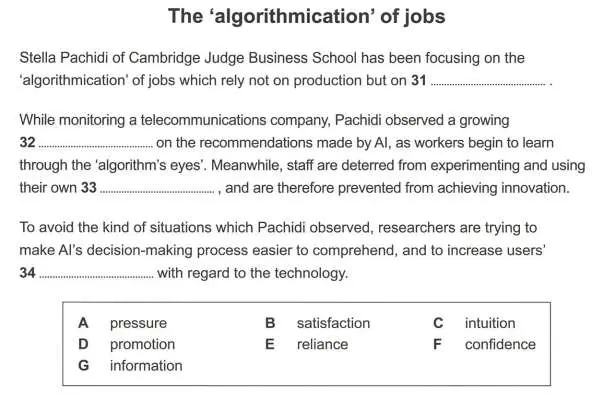
Questions 31-34
Complete the summary using the list of words, A-G, below.
Write the correct letter, A-G, in boxes 31-34 on your answer sheet.
A pressure
B satisfaction
C intuition
D promotion
E reliance
F confidence
G information
|
The algorithmication of jobs Stella Pachidi of Cambridge Judge Business School has been focusing on the algorithmication of jobs which rely not on production but on 31………………….. While monitoring a telecommunications company, Pachidi observed a growing 32…………………… on the recommendations made by Al, as workers begin to learn through the ‘algorithm’s eyes’. Meanwhile, staff are deterred from experimenting and using their own 33……………………., and are therefore prevented from achieving innovation. |
Nguồn: Internet
Questions 35-40
Look at the following statements (Questions 35-40) and the list of people below.
Match each statement with the correct person, A, B or C.
Write the correct letter, A, B or C, in boxes 35-40 on your answer sheet.
NB You may use any letter more than once.
List of people
A Stella Pachidi
B Hamish Low
C Ewan McGaughey
List of questions
35 Greater levels of automation will not result in lower employment.
36 There are several reasons why Al is appealing to businesses.
37 Al’s potential to transform people’s lives has parallels with major cultural shifts which occurred in previous eras.
38 It is important to be aware of the range of problems that Al causes.
39 People are going to follow a less conventional career path than in the past.
40 Authorities should take measures to ensure that there will be adequately paid work
Trên đây là toàn bộ đề thi Cam 16 test 1 Passage 3: The future of work, bạn có thể tham khảo bài dịch và giải thích đáp án chi tiết TẠI ĐÂY.
>> Xem thêm: Những sai lầm khi luyện IELTS Reading cần tránh và cách khắc phục
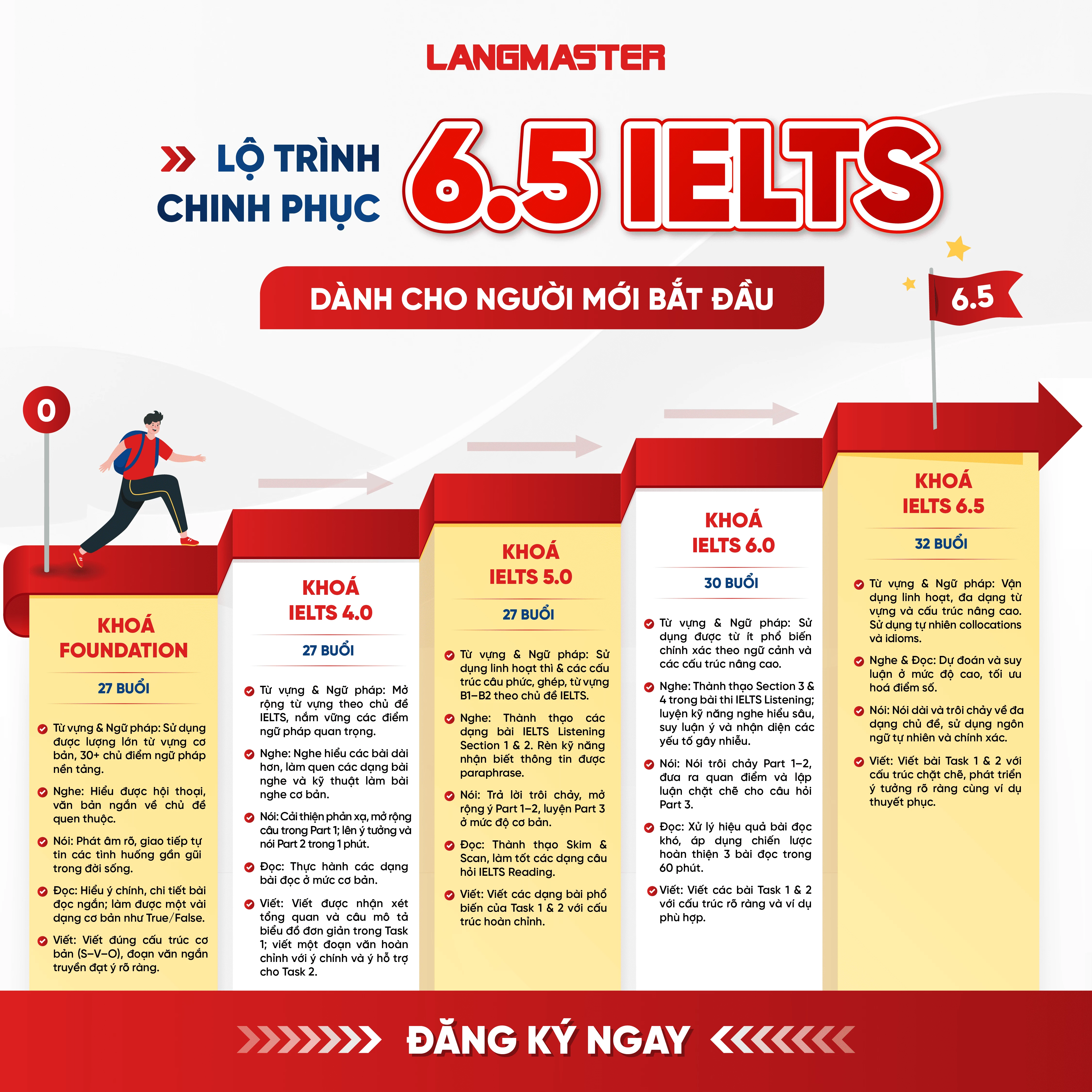
IELTS Reading tưởng chừng là kỹ năng dễ tiếp cận, nhưng thực tế lại khiến nhiều thí sinh mất điểm vì đọc lướt, hiểu sai câu hỏi và dễ mắc bẫy paraphrase tinh vi. Nguyên nhân chủ yếu xuất phát từ việc thiếu tư duy đọc học thuật và chưa nắm rõ logic ra đề. Trong số các lựa chọn hiện nay, Langmaster được đánh giá là một trong những trung tâm đào tạo IELTS uy tín hàng đầu với phương pháp giảng dạy bài bản, không chỉ giúp người học cải thiện Reading một cách bền vững mà còn phát triển đồng đều cả Listening, Speaking và Writing, hướng tới mục tiêu nâng cao năng lực sử dụng tiếng Anh toàn diện.
Ưu điểm nổi bật của khóa học IELTS Online tại Langmaster:
Đăng ký học thử IELTS Online tại Langmaster ngay hôm nay để bắt đầu hành trình chinh phục mục tiêu IELTS của bạn




Các dạng bài phổ biến và tiêu chí chấm điểm IELTS Reading chi tiết nhất: Multiple Choice, Matching Information, Matching Headings,... và hướng dẫn chiến lược làm bài hiệu quả

Những sai lầm khi luyện IELTS Reading bao gồm: dịch từng từ, đọc hết cả bài, không đọc câu hỏi trước, không quản lý thời gian, không nắm vững kỹ năng paraphrase, viết sai chính tả
![Giải đề IELTS Reading: A brief history of humans and food [full answers]](https://langmaster.edu.vn/storage/images/2025/09/20/a-brief-history-of-humans-and-food-ielts-reading-answers.webp)
Giải đề thi IELTS Reading “A brief history of humans and food” kèm full đề thi thật, câu hỏi, đáp án, giải thích chi tiết, và từ vựng cần lưu ý khi làm bài.

Tổng hợp IELTS Reading tips hay nhất giúp bạn đọc nhanh, nắm ý chính và xử lý thông tin chính xác, tự tin đạt điểm cao trong kỳ thi IELTS.
![Giải đề IELTS Reading: The importance of law [Full answers]](https://langmaster.edu.vn/storage/images/2025/09/22/55.webp)
Giải đề IELTS Reading “The importance of law” kèm đáp án chi tiết, từ vựng quan trọng và bí quyết luyện thi hiệu quả để nâng cao band điểm.





Hơn 16 năm kinh nghiệm, đào tạo thành công 800.000+ học viên
Phương pháp giảng dạy hiện đại, học viên tiến bộ rõ rệt
Lộ trình học chuẩn quốc tế, phù hợp với nhu cầu thực tiễn
Giáo viên đạt chuẩn Quốc tế với chất lượng top đầu thị trường, giàu kinh nghiệm
Học online linh hoạt, cam kết đầu ra bằng văn bản




.png)
.png)